
Effective SEO requires direction; you can make the most beautiful pages around but they won’t get you anywhere unless they’re aligned with the words your audience is searching for. A keyword research audit uncovers exactly how your target audience is trying to find you and shows you what your competitors are trying to do to reach them before you.
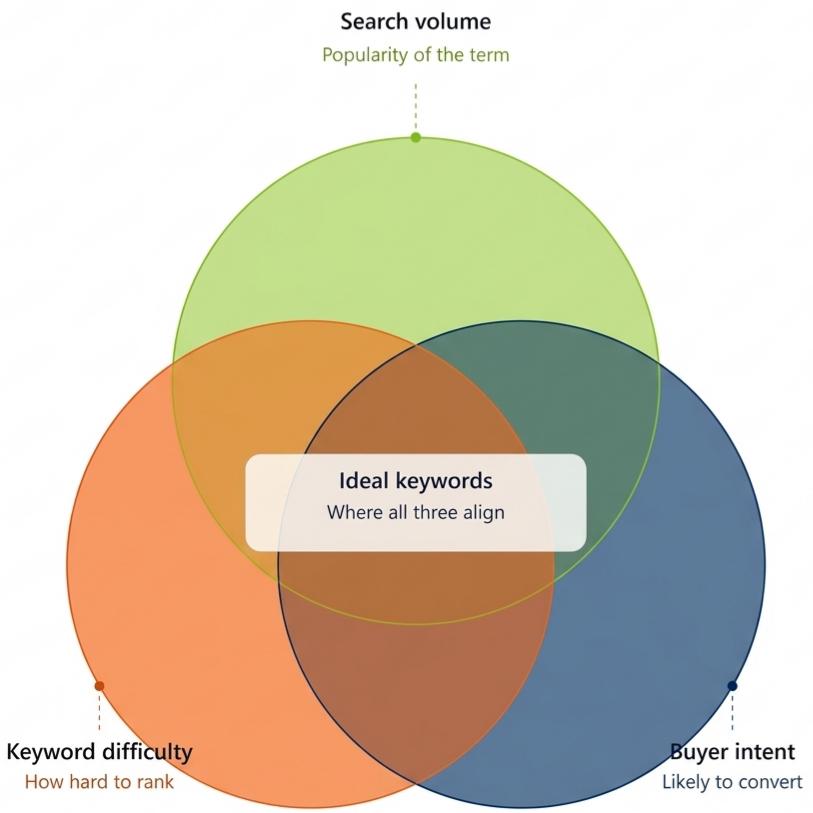
We believe that there are 3 items that should fit within the venn diagram of SEO:
What An Audit Should Uncover… & if It Doesn’t, Start Over
Most keyword audits hand you a spreadsheet full of search volume and call it a strategy. But will any of those keywords actually get you found by people ready to buy?
A real audit answers that question by connecting:
- What your buyers are searching for
- What your competitors already own
- What it will take to outrank them (on Google and in the AI tools now answering questions before anyone even opens a search bar)
Here’s what yours needs to cover if it’s going to earn its keep:
See What Is Already Working for Competitors | Discover More Valuable Keyword Opportunities | Find Keywords With the Best Ranking Potential | Evaluate the Business Value Behind Each Keyword | Reveal the Prompts Buyers Use to Find You in AI Search |
See what keywords your competitors are utilizing, and how they’re doing. | Start with a core topic and uncover related searches you may not have considered. | See which keywords are driving the largest search volume in your industry. | Go beyond raw search volume by reviewing estimated traffic, CPC data, and the actual first-page search results. | Pull prompt language straight from sales calls and AI platforms so you know exactly how buyers describe what you sell. |
[insert Keyword Research embed]
9 Reasons Why Research & Strategy Matters, Now More Than Ever (Especially With AI)

You might think that with AI, now we don’t need to do keyword research. Quite the opposite is true:
- We need traditional keyword research (using Ahrefs or SEMRush) which is a proxy for demand (market research) in Google + Bing. Even though AI has reached Google/Bing, we still need to understand what language and terminology searchers are using to seek information.
- We need to talk to the sales team + listen to recorded prospect calls to find exact prompt phrasing that people are likely using to find us in AI search.
- Creating articles on other 3rd party sites (LinkedIn, Quora, Medium, etc.) and engaging with users there can be a 1-2 punch (1 = finding other prospects, 2 = ranking that 3rd party article in traditional and/or AI search).
- AI systems don’t search the way people do: a single question can trigger 5 to 20 sub-queries behind the scenes, many of them exact-phrase, site-scoped lookups that have zero connection to search volume. That vocabulary only shows up in fan-out logs, not in Ahrefs or SEMrush.
- Most AI crawlers (OAI-SearchBot, Claude-SearchBot, PerplexityBot) don’t run JavaScript, and GA4 can’t see them at all. We check server logs first to confirm those crawlers are actually hitting your pages, because if they’re not, no amount of ranking work will fix your AI visibility.
- Rewriting what already ranks just produces another version of the same ten answers, and an AI system has no reason to cite the eleventh identical take. We research what real buyers are still stuck on, mining forums, YouTube comments, and actual sales calls, then build content around the gap nobody else has filled.
- Ahrefs’ study of 75,000 brands found that brand mentions correlate with AI Overview visibility at 0.664, more than three times stronger than backlinks. That means part of the research has to include where your name is (and isn’t) already showing up across the web, not just which pages link to you.
- Princeton’s GEO-Bench study tested nine on-page tactics against 10,000 real queries, and adding one direct quote from a named source produced the single biggest citation lift, a 41% jump. That means research has to surface real quotes and hard numbers before a word gets written, because generic claims nobody can verify get skipped by AI models and readers alike.
- Some of our clients already rank well and still don’t like how ChatGPT describes their company when a prospect asks about it. That takes research, not more content: someone has to run the actual prompts, see what the models say today, and find the gap between that answer and the one buyers should be hearing.
Here’s How Our Keyword Research Paid Off for 2 of Our Clients:
Talk is cheap. For something with a little more substance, here’s what our keyword research and SEO strategy actually did for two clients on opposite ends of the B2B spectrum: one in linens and uniforms, the other in flat-rolled steel.
- For a Linen & Uniform Service Provider, we built a diversified link profile over four years instead of chasing cheap volume, mixing skyscraper content, guest posts, .edu placements, and earned brand mentions. Referring domains grew 217% and organic traffic climbed 149%, from 21,093 to 52,651 monthly visits.
- For a National Flat-Rolled Metals Distributor & Processor, after finding 738 keyword gaps against competitors like Ryerson and Kloeckner, we built 43 new local service pages, optimized 8 Google Business Profiles, and fixed the technical issues holding the site back. SEO impressions rose 319% and overall SEO traffic grew 264%.
The Feedback We Got From Clients Cited by AI (& Ranked by Google)
Results are one thing, but hearing it from the people who signed the contract is another. These are real reviews from real clients, pulled straight from Google.


More Proof We Actually Know Our Way Around a SERP

Two client wins only tell part of the story. Here are a few deeper reads on SEO strategy and AI visibility if you want the full picture before you reach out.
- The Landing Page SEO Autopsy: 7 Pages Built to Rank, 1 Bound to Fail
- The Truth About AEO vs SEO (& Why Playing Favorites Will Hamstring Your Visibility)
- To Outsource Link Building or Not? Your Ultimate Guide to Higher SEO Ranking & More Traffic
Ready to see what a real keyword research audit looks like for your site? Book a call with our team and find out.