
Your competitors are already ranking for the keywords you want.
Nearly 97% of all clicks happen within the top 10 search results according to Ahrefs’ Ryan Law, who analyzed billions of clicks and impressions from Google Search Console (August 2025)., This means anyone sitting outside that window struggles to get found at all.
Competitor analysis SEO services exist to close that gap by studying exactly how your competitors are winning:
- Which keywords they target
- What content ranks for them
- Where their backlinks come from
At Why Stuff Sucks®, we conduct a full SEO competitor analysis before we write a single page of copy or build a single link. We identify your true SEO competitors, not just the businesses you compete with locally, uncover the keyword gaps between your site and theirs, and turn every finding into a strategy built around your niche and your target audience. The process is structured and repeatable, built to reveal exactly where your rankings, content, and link profile fall short of the sites beating you in search results.
If you’re ready to see what’s keeping you off page one, keep reading. We’ll walk through our process, then show you the results it’s produced for real clients.
6 Steps to Conduct an SEO Competitor Analysis Without Wasting a Single Month
Conducting an SEO competitor analysis without a clear process wastes time chasing the wrong signals. Here are the six steps we follow every time we conduct a competitor analysis for a new client:
- Identify Your True SEO Competitors
Your SEO competitors aren’t always the businesses you compete against for customers. We start by identifying the sites that actually rank for your target keywords in search engines, using an SEO tool like Semrush or Ahrefs to confirm who’s really occupying the SERP.
- Spy on Their Full Keyword Universe
Once we know who your competitors are, we pull every keyword they rank for to understand the full scope of their SEO strategy. This gives us a complete map of the terms driving their traffic, from high-volume queries to long-tail keyword opportunities.
- Find the Keyword Gaps Between You and Them
With their keyword universe mapped, we compare it against yours to uncover the keyword gaps holding your site back. These gaps often reveal keyword opportunities your competitors haven’t fully optimized either.
- Analyze Their Content Strategy
Ranking keywords don’t mean much without the content strategies behind them, so we study the type of content each competitor publishes. We look at format, depth, and structure to figure out what search intent their pages are actually satisfying.
- Conduct a Link Gap Analysis
Backlinks remain a major ranking factor, so we run a link gap analysis to see which websites link to your competitors and not to you. This tells us exactly where to focus outreach to close the gap and build genuine authority.
- Turn Your Findings Into an Actionable Strategy
Data without direction doesn’t move rankings, so every insight gets translated into an actionable plan. We prioritize the keyword gaps, content strategies, and link opportunities most likely to improve your search engine rankings fastest.
The 2 Kinds of SEO Competitors Hiding in Your Search Results

Not every SEO competitor sells what you sell. Search engines rank pages based on keywords and search intent, which means your real competition in the SERPs often looks nothing like your competition on Main Street. Understanding the difference determines where you focus your competitor analysis and which sites are actually worth tracking.
Direct Competitors: The Businesses Fighting You Keyword by Keyword
Direct competitors sell the same products or services to the same target audience, and they show up in the same search results you’re trying to rank in. If you run a manufacturing company in Green Bay, your direct competitors are the other manufacturers targeting the same city and the same industry keywords.
These are the sites worth watching closest during a competitor analysis, since their content strategies and backlink profiles are the most directly comparable to yours. A strong SEO competitive analysis should always start here before expanding outward.
Indirect Competitors: Different Business, Same Search Real Estate
Indirect competitors don’t sell what you sell, but they still compete for your search real estate. A software review blog and a software company selling the same product can end up ranking for identical keywords, even though only one of them is actually selling anything.
Ignoring indirect competitors is a common mistake in SEO competitor analysis, since these sites often outrank actual businesses by publishing high-quality, informational content that search engines reward. Uncovering them early keeps your keyword strategy grounded in reality instead of guesswork.
Business Results That Prove Our SEO Strategies Work in the Real World
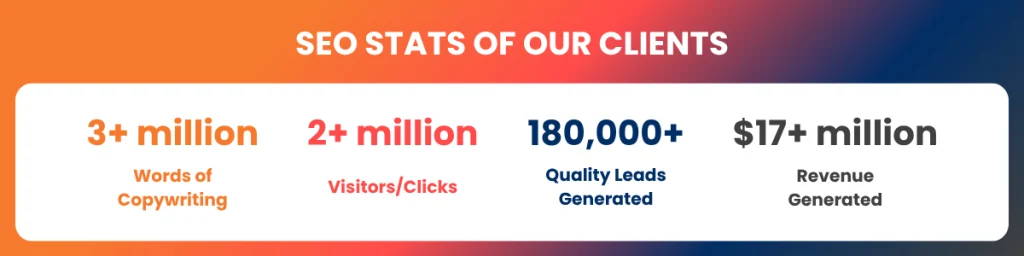
Competitor analysis only means something when it produces results you can measure. Every strategy we build starts with a full SEO competitive analysis, and the numbers below show what happens when keyword gaps, content strategies, and link building actually get executed instead of just reported on.
Proven Professional Benefits | |
One industrial client yielded a 319% increase in SEO impressions | A SaaS provider received a 405% boost to SEO clicks in the first 12 months |
Referring domains increased by 217% over 4 years for one service client | One B2B client’s local pages impressions and clicks from SEO grew 142% & 255% respectively |
The 8 Other SEO Research Angles to Consider Besides Competitor Analysis

Competitor analysis is a critical part of any SEO strategy, but it works best alongside other research angles. Here are eight additional areas worth conducting alongside your competitor analysis to build a more complete strategy:
- Technical SEO Audit
A technical SEO audit checks the parts of your site search engines can’t ignore, like site speed, crawlability, and indexation. Even a strong keyword strategy underperforms if technical issues are blocking search engines from ranking your pages.
- Prompt gap analysis for AI SEO (AEO, GEO, etc.)
As AI Overviews and chat-based search grow, a prompt gap analysis looks at which questions competitors get cited for in AI answers and which ones you don’t. This informs AEO and GEO strategy the same way keyword gap analysis informs traditional SEO.
- Local SEO audit
A local SEO audit reviews your Google Business Profile, local citations, and map pack visibility against nearby competitors. This matters most for businesses relying on local search traffic to drive in-person or regional customers.
- Regional SEO Strategy
A regional SEO strategy targets multiple cities or states within a broader service area instead of a single location. It requires its own competitive analysis, since ranking factors and competitors can shift significantly from region to region.
- Multilingual/International SEO Strategy
A multilingual or international SEO strategy adapts your content and keyword targeting for different languages and countries. Competitor research looks different here too, since search intent and top-ranking sites vary by market.
- SEO Site Migration
An SEO site migration protects your rankings when you change domains, platforms, or site structure. Without careful planning, a migration can hand your hard-won rankings straight to the competitors you just analyzed.
- Multilocation SEO Strategy
A multilocation SEO strategy builds and optimizes individual location pages for businesses with several physical or service locations. Competitors here often overlap with your direct competitors identified earlier, just multiplied across more markets.
- Site Architecture Optimization
Site architecture optimization organizes your pages so search engines and visitors can find what they need without friction. A clean structure also makes it easier to close keyword gaps by giving new content a logical home.
Stop Reading About Competitors, Start Outranking Them
Every keyword gap, content gap, and link gap we’ve covered so far means nothing until someone acts on it. Your competitors already have a head start in search engine rankings, and that gap only gets wider the longer it goes unaddressed.
Reach out now and we’ll run a real competitor analysis on your site, not a generic template. You’ll see exactly which keywords, pages, and links are keeping your competitors ahead, plus a clear plan for closing the distance.
Competitive Analysis Pricing: Pick the Growth Speed That Fits Your Budget
Monthly Investment | Minimum Timeframe | How Fast Lead/Sales Growth? |
Less than $5,000 | 3-6 months | Not recommended. Too slow, not enough ROI. |
$5,000 | 12+ months | Baseline |
$10,000 | 12+ months | Moderate |
$15,000+ | 12+ months | Aggressive |
$20,000+ | 12+ months | Highly Aggressive |
Competitor analysis and the SEO work that follows it aren’t instant, no matter what budget you choose. The investment level mostly determines how many keyword gaps, content pieces, and link building efforts we can tackle each month, which directly affects how fast you see movement in search engine rankings.
Lower budgets can still produce results, just at a slower pace and with a narrower focus. Higher budgets let us pursue more keyword opportunities and competitor gaps at once, which tends to compound into faster, more aggressive growth.
Don’t Take Our Word for It: Real Reviews From Real Clients We’ve Analyzed For




Frequently Asked, Rarely Answered: 9 Informational FAQs on Competitor Analysis

These are the questions we hear most from clients considering competitor analysis SEO services. Most of them come up after a prospect has already read through our process and wants the details we didn’t spell out above.
- What Is an SEO Competitor Analysis, Exactly?
An SEO competitor analysis is the process of studying the keywords, content, backlinks, and technical setup of the sites outranking you in search engines. The goal is to find specific, actionable gaps between your site and theirs that you can close.
- How Often Should You Conduct One?
Most businesses benefit from a full competitor analysis at least once or twice a year, with lighter check-ins in between. Industries with fast-moving competitors or frequent algorithm impact may need to conduct one more often.
- What Tools Are Used to Analyze Competitors?
We rely primarily on Semrush and Ahrefs to pull keyword, backlink, and traffic data for both your site and your competitors. These tools give us the raw data, but interpreting it into an actionable strategy still takes manual analysis.
- Is Competitor Analysis the Same as Keyword Research?
Keyword research is one piece of a competitor analysis, but it isn’t the whole picture. A full competitive analysis also covers content strategy, backlink profiles, and technical SEO, not just which keywords to target.
- How Long Before You See Results?
Most clients start seeing movement in search engine rankings within three to six months, though competitive niches can take longer. Results depend heavily on how aggressively the findings from the competitor analysis get implemented.
- Can You Conduct a Competitor Analysis Yourself?
Yes, with an SEO tool like Semrush or Ahrefs and enough time, you can conduct a basic competitor analysis on your own. Where most DIY efforts fall short is turning that raw data into a prioritized, actionable strategy instead of a spreadsheet full of numbers.
- What Metrics Matter Most in the Analysis?
Keyword difficulty, search volume, referring domains, and current ranking position matter most when evaluating competitors. We weigh these against your niche and target audience rather than chasing metrics that look good but don’t drive relevant traffic.
- Does This Work for Every Industry?
Yes, competitor analysis applies to any industry with searchable keywords and competitors trying to rank for them. The specific tactics shift by niche, but the underlying process of uncovering gaps stays the same.
- What Happens After the Analysis Is Complete?
Once the analysis is complete, we build a prioritized action plan covering content, links, and technical fixes ranked by potential impact. That plan becomes the foundation for the ongoing SEO strategy work that follows.
Ready for an Actionable Competitor SEO Analysis? Let’s Talk

A competitor analysis only matters if it leads to action, and that’s exactly what we build next. Once we know which keywords, content gaps, and link opportunities your competitors are exploiting, we turn that research into a strategy built around your business, your budget, and your target audience. No template, no recycled playbook, just a plan based on what’s actually happening in your search results right now.
If you’re ready to see exactly where your competitors are beating you and what it takes to change that, contact us and we’ll walk you through what a full competitor analysis looks like for your business. Book a call, and let’s figure out your competitive edge together.