Most landing page SEO advice treats every page the same way: stuff a keyword in the title, add a meta description, call it done. That approach explains why so many landing pages sit on page four of Google, quietly costing companies leads they never see.
We’ve crawled through hundreds of client pages at Why Stuff Sucks®, and the same pattern shows up every time: seven distinct page types can carry real ranking weight when they’re built correctly, each one a SEO-friendly landing page designed around a single purpose, a single keyword, and a single visitor. But there’s an eighth pattern hiding on almost every site we audit, and it actively works against everything the other seven are trying to do.
We’ll break down:
- What separates a landing page that ranks from one that quietly disappears into the index
- The traits search engines reward
- The structure that makes pages easy to crawl and easy to read
- The exact page type that tends to cannibalize a site’s own rankings
8 Must Haves for Search Engine Optimization to Rank Any Landing Page on Traditional or AI Search

Search engine optimization for landing pages used to be a competitive advantage. Now it’s table stakes. Google’s AI Overviews and other AI search tools pull from many of the same signals traditional rankings always cared about, and we broke down how those two systems actually differ in our AEO vs. SEO breakdown.
Here’s the honest part: the five items below won’t make a landing page stand out anymore. Every SEO-friendly landing page needs them just to be considered for either ranking system. Treat this as your baseline, not your differentiator. You’ll need:
- Keyword-Optimized, Search-Intent Matched Content
- A Single, Clear Page Title and Meta Description
- Fast Page Load Speed
- Mobile-Friendly, Responsive Design
- Primary Keyword in 5 Fields (H1, Body under H1, Meta Title, Meta Description, Url Slug)
The five items above get a landing page into the conversation. The eight below are where landing page SEO best practices start requiring judgment instead of a checklist. Work through these eight in order, and most landing pages see meaningful movement in search engine results pages within a few months.
- Proper Header Hierarchy, Built as an Outline Before You Write
Search engines read header tags as a table of contents for a page, so a landing page with one H1, clearly nested H2s, and supporting H3s tells Google exactly how the content is organized. Skip levels or stack multiple H1s on one page, and that signal gets muddy fast.
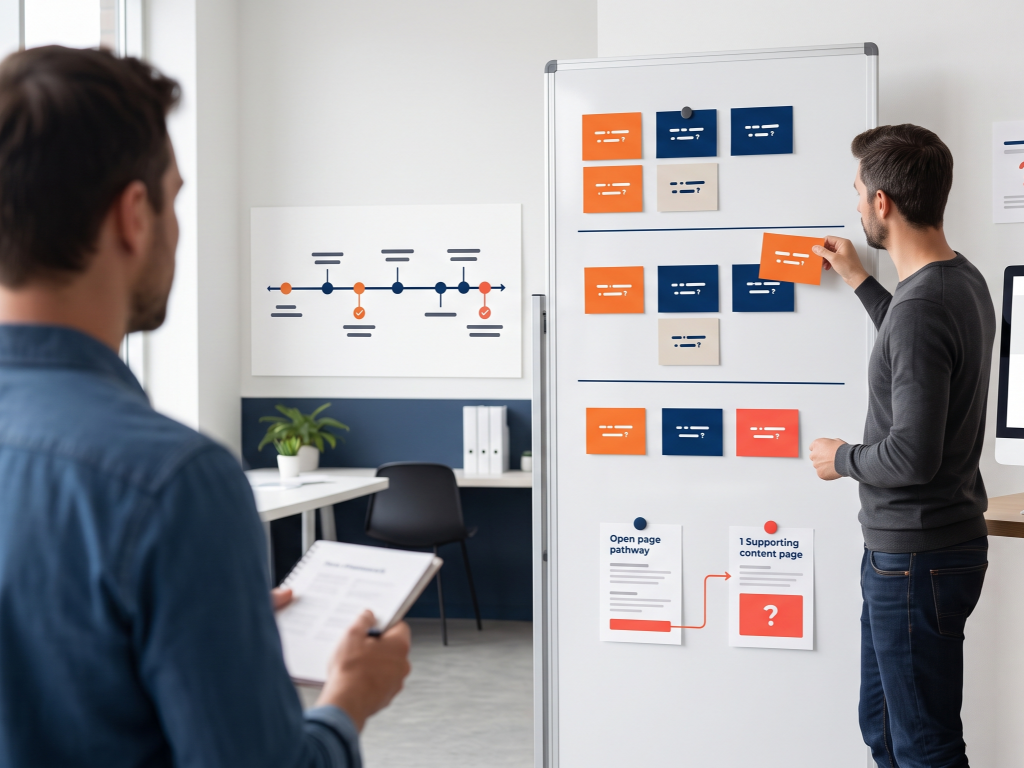
The way to get this right consistently: sketch what each H2 and H3 needs to accomplish for the reader before writing a single sentence of body copy. A page built from an outline reads clearly and ranks more predictably than one where headers get bolted on afterward to break up a wall of text.
- Internal Links to Relevant Pages
Linking a landing page to other relevant pages on the same site distributes ranking authority instead of trapping it on the homepage alone. This matters even more once you’re building pages across multiple cities or regions, since Google needs to understand how those pages relate to each other instead of treating each one as an island.
- Trust Signals That Are Both Earned & Displayed: Reviews, Testimonials, & Case Studies
A landing page that only makes claims about itself is a landing page most visitors won’t believe, and search engines are increasingly built to weigh that gap too. Ask past clients directly for a review right after a project wraps, and build short case studies from wins you can already prove (then make sure they’re actually visible on the page itself, not buried in a footer). One strong testimonial placed near the call to action does more for conversions than a full page of generic praise no one scrolls to.
- Break Up Long Copy With Scannable Lists (Bulleted or Numbered)
Long paragraphs push visitors to skim past the parts that matter, and skimming visitors bounce fast. Numbered lists and bullet points break a landing page’s content into pieces a reader can scan in seconds and still walk away with the point.
- Close With a Strong, Singular Call to Action (& Have 1 in the Middle too)
Every landing page needs one clear next step for a visitor to take, not three competing buttons fighting for the same click. Place a soft call to action partway down the page for visitors who are ready early, then close with a stronger version for everyone who read the whole page.
- EEAT: Properly Linked Author Profile/Byline at the End of Each Article
Google’s own guidance on creating helpful content calls out author bylines as a direct signal of who’s responsible for what’s on the page. Link the author’s name to a real bio with credentials and a body of published work, and a landing page’s experience, expertise, authority, and trust becomes easier for readers and search engines alike to verify.
- Structured Data & Schema Markup
Schema markup tells search engines exactly what a landing page is — a product, a service, an FAQ, a local business; instead of leaving it to infer. A landing page with the right schema type becomes eligible for richer search results (star ratings, FAQ dropdowns, price ranges) that a plain blue link can’t compete with.
- Ongoing Core Web Vitals Monitoring, Not a One-Time Launch Check
“Fast page load speed” in the baseline list above is a yes/no launch check. This is the advanced version: Core Web Vitals drift over time as a page picks up new images, scripts, and third-party embeds, so a page that passed at launch can quietly fail eighteen months later. Monitoring this on a recurring basis, not just once, is what separates a page that ranks and stays ranked from one that slips without anyone noticing why.
7 Styles of SEO-Friendly Landing Pages Hiding on Your Site (+ 1 That Can Harm Your SEO)

Not every landing page on a site is doing the same job, even when they look similar at a glance. Product pages sell, article pages inform, location pages capture local searches, and each type needs its own approach to actually rank.
Most sites already have several of these SEO-friendly landing pages live right now, built with SEO in mind or not. Businesses that treat each type deliberately, matching structure and content to the specific job it does, tend to pull far more organic traffic than sites running one generic template for everything.
Product Pages That Do Double Duty: Selling & Ranking
A product page’s first job is converting a visitor into a sale, but a well-built product page can also become one of the strongest landing pages for SEO on the entire site. Long-tail keywords around specific product features or use cases send buyers directly to a page that’s already built to close.
The trick is not treating the product description as an afterthought below a photo gallery. Include the details a searcher is actually looking for (materials, sizing, use case, minimum order quantities), structured under real headers instead of one dense paragraph. A product page optimized this way ranks for searches a generic category page never will, and it converts better once it gets the traffic.
The Industry Page Advantage: Niche Content, National Reach
Industry pages target a specific vertical (manufacturing, healthcare, legal, IT) with language, pain points, and case studies aimed at that audience instead of a generic pitch. That specificity is exactly what search engines reward, since a page written for one industry ranks far more easily for that phrase than a page trying to serve everyone at once.
We covered this approach in depth for a related niche in our piece on SEO for IT companies, and the same principle holds across industries: a page written for one specific type of buyer will out-rank a page trying to speak to all of them.
Service Pages: The Backbone of B2B Search Visibility
Service pages carry more B2B search volume than almost any other page type, because buyers searching for a specific service already know what they need and are close to a decision. That makes the service page one of the most valuable landing pages on a B2B site, and one of the most commonly under-optimized.
Each service needs its own page, its own keyword focus, and its own proof points, not a shared page trying to cover five services in one scroll. A visitor searching for one specific service should land on a page built entirely around that service, with the trust signals and case studies to match.
Location Pages: How to Rank in Every City Without Duplicating Yourself
Location pages let a business rank in dozens of cities or regions without needing a physical office in every one, making them one of the highest-leverage landing page types for any business expanding its service area. The catch is that most location pages fail exactly because they’re built from a copy-paste template with only the city name swapped out.
A location page that actually ranks includes real, city-specific details: local case studies, service area zip codes, and references to the local market that a generic template can’t fake.
Play The Long Game of Organic Traffic With Article Pages
Article pages, like this one, aren’t built to convert on the first visit. They’re built to answer a question a potential buyer is already searching for, build trust along the way, and earn a spot in the consideration set long before that buyer is ready to talk to sales.
The payoff is slower than a product or service page, but article pages compound. A well-optimized article can keep ranking, and keep sending qualified traffic, for years after it’s published, with only occasional updates needed to keep it current.
Home Pages: Your First Impression, First Ranking Signal
A home page has to do more jobs at once than any other page on a site: explain what the business does, establish credibility, and point different visitors toward the specific page that matches what they actually came for. That combination makes home pages notoriously hard to optimize for a single keyword, since they’re rarely trying to rank for just one.
The best approach treats the home page as a hub, optimized for the business’s core, broadest keyword, with clear paths pointing toward the product, service, industry, and location pages built to rank for everything more specific.
Category Pages: The Overlooked Workhorse of Site Structure
Category pages organize a site’s products or services into logical groups, and they quietly do a lot of SEO heavy lifting by giving search engines a clear structure to crawl and visitors a clear path to browse. A site without well-built category pages forces both Google and visitors to work harder than they should to find what they’re looking for.
Treat category pages as more than a list of links. A short block of original copy explaining what’s in the category, and why it’s organized that way, gives the page something to actually rank for instead of just existing as a directory.
How Duplicate Pages Quietly Wreck Your SEO Performance
Every landing page style above works because it’s distinct. The moment two pages target the same keyword with nearly identical content, whether that’s two location pages with swapped city names or two service pages copied from the same template, search engines can’t tell which one deserves to rank. Usually, the answer ends up being neither.
This is called keyword cannibalization, and it’s one of the most common ways businesses accidentally sabotage their own landing page SEO while trying to scale it. Instead of one strong page ranking in position one, two weak, competing pages split the same authority and often both land buried on page two.
The fix isn’t fewer pages. Companies with 10 to 15 landing pages generate 55% more leads than companies with fewer than 10, according to HubSpot’s research, and that number climbs further from there. The fix is making sure every page earns its place with content a competing page on your own site doesn’t already cover.
How Leveraging User Generated Content Yields A Powerful Boost of AI Visibility
As one of the internet’s largest online messaging boards, a large quantity of AI’s training comes from forums like Reddit. As a result, the more your customers are talking about you online, the more AI scanning the web will see that you’re not only effective, but that you’re relevant.
An AI can never really try your services or products for themself, so they’ll rely upon the word of people on the internet from X (formerly Twitter) to Reddit to Quora, and even in your Google Business Profile or review sites like G2 & TrustPilot.
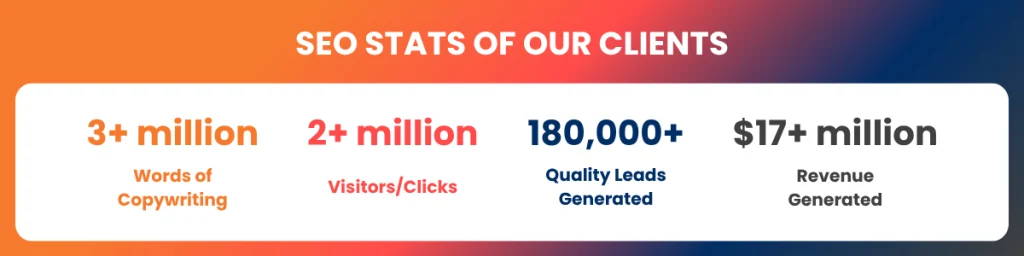
For one of our clients, a law firm, AI search increased:
- 26% visibility in AI search vs competitors at 17%, 12% & 9% for key topics that matter to them.
- AI sessions are up 16% Last 365 vs previous 365.
Just like standard SEO, third-party endorsements boost authority for AI agents seeking to evaluate which service is best for a particular query. The more reviews you have and the more online mentions your business is generating, the more likely an AI is to rank you highly and recommend you to a user.




The 9 Landing Page SEO Questions We Get Asked Most
These are the landing page SEO questions that come up in nearly every client call, regardless of industry. Most have a straightforward answer once you understand what search engines are actually trying to evaluate.
- How Long Does It Take for a New Landing Page to Rank?
Most new landing pages need three to six months to reach a stable ranking, assuming the page targets a realistic keyword and the rest of the site has some existing authority. Highly competitive keywords or a brand-new domain can push that timeline out considerably longer.
- Should PPC Landing Pages Be Indexed by Search Engines?
Not always. A PPC landing page built purely to match one ad’s exact message often has thin, repetitive content that can hurt a site’s overall SEO if search engines index it, so many marketers block those specific pages from indexing while keeping their organic landing pages fully visible.
- Do Landing Pages Need to Be Linked to From a Blog?
They don’t need to be, but it helps considerably. A blog post that links to a relevant landing page passes along some of its own ranking authority and gives search engines another path to discover and understand that page.
- How Many Words Should an SEO Landing Page Have?
There’s no fixed word count that guarantees a ranking, and padding a page with filler to hit a number usually backfires. The right length is whatever it takes to fully answer the search intent behind the keyword, which might be 400 words for a simple service page or 2,000+ for a complex comparison.
- Can One Landing Page Target Multiple Keywords?
Yes, as long as those keywords share the same search intent and the page can address all of them without diluting the content. Forcing one page to rank for keywords with different intents, like a broad service term and a specific city name, usually means it ranks weakly for both instead of strongly for one.
- How Often Should Landing Pages Be Updated?
A landing page targeting a stable, evergreen keyword can go a year or more between updates if the content still holds up. Pages tied to pricing, availability, or anything that changes regularly should get reviewed at least quarterly to keep the information accurate and the page trustworthy.
- Do Landing Pages Need Backlinks to Rank?
Backlinks help, especially for competitive keywords, but they’re not always required for less competitive, more specific terms. A location or service page targeting a narrow, low-competition keyword can rank on strong on-page SEO and internal links alone.
- Should Landing Pages Be Gated Behind a Form?
Gating a landing page behind a form blocks search engines from indexing anything past that wall, along with most visitors who aren’t ready to hand over their information yet. Reserve gating for high-value offers like a detailed guide or tool, and keep core informational and service pages open for both visitors and search engines to access.
- Can a Landing Page Rank Without Any Paid Traffic?
Yes. A landing page built around real search intent, solid on-page SEO, and internal links can rank and generate organic traffic with zero ad spend behind it. Paid traffic can accelerate results and provide useful conversion data, but it’s not a requirement for ranking.
Let’s Create Landing Pages Built to Rank, Not Just Look Good

A landing page that only looks good in a design review isn’t actually doing its job if it never shows up in search. Every principle in this guide, from header structure to internal linking to avoiding duplicate content, exists to get a page found by the people already searching for what it offers. Getting all seven page types working together, without the eighth pattern quietly undoing your progress, takes more than a one-time audit.
We build and audit landing pages for clients across industries with exactly this approach: distinct page types, real search intent, and a structure search engines and visitors can both follow. Some pages need a full rebuild, others just need the duplicate content problem cleaned up and a header hierarchy that finally makes sense.
If your landing pages are live but invisible, contact us and we’ll help you figure out exactly where to start.