
Home services SEO is the practice of optimizing a home service company’s website and online presence to rank at the top of local search results when potential customers are actively looking to hire. For HVAC companies, plumbing businesses, pest control providers, roofing contractors, and other home service providers, search engine optimization is the highest-ROI marketing channel available.
It puts your business in front of people who are already searching for exactly what you offer, in your service area, right now.
Here’s why that matters at scale: According to industry data, 46% of all Google searches are local, and businesses appearing in the top three local search results receive 70% of all clicks. For a home services company generating $1M or more annually, even a modest improvement in search rankings translates directly into more high-quality leads, more booked jobs, and a more defensible position against competitors who are spending heavily on Google Ads just to stay visible.
This guide covers the full picture: local SEO, Google Business Profile optimization, keyword research, technical SEO, content strategy, link building, and reputation management. It’s built for home service companies that are serious about organic growth, not just tinkering around the edges.
The Quick-Reference Guide to Home Services SEO (Start Here)

Before the deep dive, here’s a fast-reference checklist for home service businesses that want to immediately evaluate their current SEO strategy:
- Google Business Profile: Is it fully built out with services, photos, hours, and a keyword-rich description?
- Service pages: Does every service you offer have a dedicated, optimized page?
- Location pages: Do you have individual pages for every city or service area you cover?
- Keyword research: Are your target keywords based on what customers actually search, including high-intent local variants?
- Title tags and meta descriptions: Is every page optimized with relevant keywords and a clear reason to click?
- Mobile performance: Does your site load in under three seconds on mobile devices?
- Technical SEO: Is your site secure (HTTPS), crawlable, and free of broken internal links?
- Review velocity: Are you consistently generating new Google reviews and responding to all of them?
- Backlinks: Are credible sites in your industry and local area linking to your website?
- Conversion elements: Does every service page have a visible phone number, clear CTA, and trust signals like licensing and insurance?
Each of these is covered in full below.
Do Google Ads Outperform SEO at Scale? An Honest Comparison
Paid search gets home service companies visible fast. For some situations, that speed is worth paying for. But at the revenue levels where paid search costs start to compound, the math shifts toward organic traffic in a way that’s hard to ignore.
Here’s a direct comparison of how SEO and Google Ads stack up for home service companies operating above $1M in annual revenue:
|
SEO |
Google Ads |
|
|
Cost structure |
Ongoing investment with compounding returns |
Pay-per-click with no residual value |
|
Lead quality |
High-intent organic searches |
High-intent but expensive per lead |
|
Cost per lead over time |
Decreases as rankings strengthen |
Stays flat or increases as competition grows |
|
Visibility when budget stops |
Maintained |
Gone immediately |
|
Local Map Pack presence |
Driven by SEO signals |
Not influenced by ad spend |
|
Trust signal to searcher |
High: organic results are trusted more |
Lower: users know it’s a paid placement |
|
Timeline to results |
3 to 6 months to gain traction |
Immediate |
|
Long-term ROI |
Strong and compounding |
Dependent on ongoing spend |
The average cost-per-click for competitive HVAC, plumbing, and pest control keywords runs between $15 and $60 per click depending on market. A company generating 200 leads per month from paid search alone is spending $3,000 to $12,000 monthly just to hold position. Pull the budget and the leads stop the same day.
Organic search doesn’t work that way. According to growth research, local SEO generates 300% more leads compared to non-optimized sites, with 88% of local mobile searches leading to a call or visit within 24 hours. For home service businesses built to handle real lead volume, SEO builds equity. Paid search rents it.
7 Reasons Your Google Business Profile Is Your Most Valuable Piece of Digital Real Estate
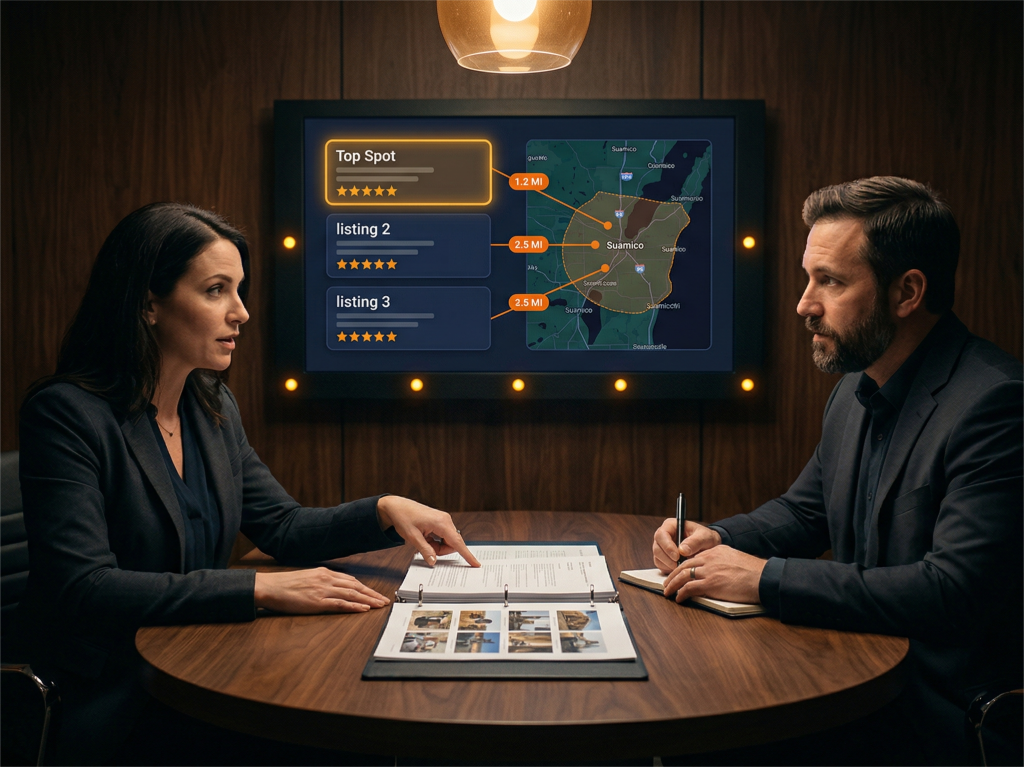
For any home service company competing in local search, the Google Business Profile is the asset that drives Map Pack rankings. The Map Pack is where phones ring. Getting it right is non-negotiable.
Here’s what a fully optimized Google Business Profile includes:
- Accurate NAP (name, address, phone number) consistent with every other listing on the web. Inconsistencies confuse search engines and suppress local rankings.
- Precise primary and secondary categories that match your services. “HVAC Contractor” and “Air Conditioning Contractor” rank for different searches. Category selection matters more than most companies realize.
- Service listings with descriptions that incorporate relevant keywords naturally. Don’t leave this section empty.
- Real photos of completed jobs, branded vehicles, uniformed technicians, and equipment. Stock images signal nothing. Authentic job photos signal trust and activity.
- A keyword-rich business description that leads with what you do and where you do it, written for a homeowner who has never heard of your company.
- Regular Google Posts covering seasonal offers, emergency availability, and real job examples. Posting consistently signals to Google that the business is active.
- Review velocity and responses treated as an ongoing priority, not a quarterly project.
Nearly 87% of customers won’t consider a home service business with low ratings, according to ServiceTitan research. Review velocity, meaning how consistently new reviews come in, is a direct local ranking signal.
Building a system to request reviews from every completed job, whether through automated post-service texts or email follow-ups with a direct Google review link, is one of the highest-leverage moves in home services SEO.
6 Tips to Find the Keywords That Actually Bring in Paying Customers
Keyword research for home service businesses is about intent first and volume second. The goal is identifying the specific phrases that paying customers type when they’re ready to hire, then optimizing the right pages to rank for those phrases.
Here are six principles that separate effective keyword research from wasted effort:
- Prioritize high-intent local keywords above everything else.
Searches like “furnace repair [city],” “pest control company near me,” or “licensed electrician [zip code]” come from people ready to call. These anchor your core service pages.
- Build out every service category with its own keyword set.
A plumbing business shouldn’t only optimize for “plumber [city].” It needs dedicated pages targeting “water heater installation,” “sewer line repair,” “drain cleaning service,” and every other core offering. One page can’t capture all of that demand.
- Target related keywords and long-tail variants for blog content.
Questions like “how much does AC replacement cost” or “signs you need a new roof” attract homeowners in the research phase, build topical authority, and feed the pipeline before competitors enter the picture.
- Use real tools, not guesswork.
Google Search Console shows which queries are already driving impressions. Ahrefs and SEMrush reveal competitor keyword gaps. Google Keyword Planner provides search volume data. These tools take the speculation out of the process.
- Never keyword stuff.
Forcing a target keyword into copy at an unnatural density is a technical SEO penalty risk. Natural integration across title tags, meta descriptions, headers, and body copy is the standard.
- Revisit keyword strategy quarterly.
Search behavior shifts with seasons, local competition, and algorithm updates. A keyword strategy set once and never reviewed goes stale fast.
What Does Every High-Performing Home Services Website Get Right on the Page?

On-page SEO is the process of making sure each individual web page is built to rank for its target terms and convert the visitors it receives. Here’s what separates the pages that rank from the ones that don’t:
- Title tags
are the single most important on-page element. Every service page and location page needs a unique title tag leading with the target keyword. “HVAC Repair in Milwaukee | [Company Name]” outperforms “Services | [Company Name]” for both rankings and click-through rate from search engine results pages.
- Meta descriptions
don’t directly affect rankings, but they determine whether someone clicks your listing over a competitor’s. A meta description for a pest control service page should name the service, the location, and give a clear reason to click. Not the company mission statement.
- Service pages
need depth. Each core service deserves its own dedicated page with at minimum 600 to 800 words of useful, keyword-rich content describing the service, the process, why a homeowner would need it, and what distinguishes this company. Thin pages with three sentences and a contact form don’t rank against competitors who have invested in real content.
- Location pages
require genuine differentiation. A home services company serving 12 cities needs 12 individual pages, each built with local keyword variants and content that reflects real familiarity with that market. Duplicate pages with only the city name swapped out are a technical SEO liability.
- Internal links
connect the full site into a coherent structure. Service pages should link to relevant location pages. Blog posts should link to corresponding service pages. Everything should point toward the contact or booking page. A well-linked site distributes ranking authority efficiently and helps search engines understand topic relationships.
Ready to Build an SEO Strategy That Fills Your Pipeline?
Hiring an SEO consultant means less guessing and more results. You get:
- A clear strategy tailored to your service area
- Expert insights that help you avoid common mistakes
- Consistent tracking to know what’s working
No more wasting time trying to figure it all out yourself.
An expert can help you turn your site into a steady source of calls, leads, and new customers. If you want more visibility in search results, better keyword rankings, and a local presence that actually brings in business, we’re here to help.
Contact our team or call us at 920-538-5833 to start building a plan that works for your goals. One conversation could be the shift your SEO has been waiting for.
Find & Fix The Technical Stuff That’s Quietly Killing Your Search Rankings
Technical SEO is the foundation everything else sits on. Strong content and solid backlinks still won’t produce results if Google can’t crawl the site properly, if it loads too slowly, or if it fails basic security standards. Here’s what to audit:
|
Technical Factor |
What to Check |
Why It Matters |
|
Website security (HTTPS) |
Is the site running on a secure certificate? |
Google confirmed HTTPS as a ranking signal. HTTP sites send a trust signal in the wrong direction. |
|
Mobile-friendly design |
Does the site load and display correctly on phones? |
Google uses mobile-first indexing. Mobile performance determines rankings, not desktop. |
|
Page speed |
Does the site load in under 3 seconds? |
Core Web Vitals are a ranking factor. Use Google PageSpeed Insights to identify specific issues. |
|
Crawlability |
Is there a submitted XML sitemap? Are there broken internal links? |
Search engines follow links to discover pages. Broken links and missing sitemaps create indexing gaps. |
|
Canonical tags |
Are duplicate pages properly canonicalized? |
Duplicate city pages without canonical tags split ranking authority and can suppress rankings. |
|
Schema markup |
Is LocalBusiness, Service, FAQ, and Review schema implemented? |
Structured data helps Google understand page content and can improve how listings appear in search results. |
|
Core Web Vitals |
What are the LCP, FID, and CLS scores? |
Google uses these as direct ranking inputs. Poor scores hurt both rankings and user experience. |
Run a full site audit using Screaming Frog, Ahrefs, or SEMrush at least twice a year. Technical issues compound silently. By the time rankings drop noticeably, the underlying problem has often been present for months.
Is 1 Service Area Page Enough? Probably Not…

One generic “service areas” page listing 12 cities in a bulleted list is not a local SEO strategy. It’s a placeholder. Here’s why it falls short and what to do instead.
Search engines rank individual web pages, not websites as a whole. When a homeowner in a specific city searches for “HVAC repair [city name],” Google looks for a page that is specifically relevant to that search. A generic service area page that mentions the city once in a list doesn’t compete with a competitor who has a full dedicated page built around that city and that service.
What effective location pages include:
- A unique title tag and meta description incorporating the city name and primary service keyword
- A page headline that references both the service and the specific location
- Body content that reflects genuine local familiarity, including neighborhood references, local landmarks, or service-specific considerations for that market
- The company’s phone number and service area details specific to that location
- A Google Map embed or directions reference
- Customer reviews or testimonials from that specific area where possible
- Internal links to relevant service pages and back to the main service hub
For a home services company operating across 10 or more markets, building out this page structure is a significant content investment. It’s also one of the highest-return SEO investments available, because each location page creates a new entry point for high-intent local searches in that market.
6 Ways Home Service Companies Earn the Backlinks That Move the Needle
Backlinks from credible sites remain one of the strongest signals in Google’s ranking algorithm. For home service businesses competing in local markets, the goal is earning valuable backlinks from sites that are relevant to the industry, the geographic area, or both.
Here are the most effective link-building channels for home service companies:
- Industry Directories
Platforms like Angi, HomeAdvisor, Houzz, and trade-specific directories like PHCC for plumbing businesses or ACCA for HVAC companies provide high-authority listings that pass real ranking signals. Claim them, complete them fully, and keep them updated.
- Local Citations
Chamber of Commerce listings, city business directories, and neighborhood association websites provide local relevance signals that directly support Map Pack rankings. Name, address, and phone number must be identical across every citation.
- Guest Blogging
Contributing articles to home improvement publications, local news outlets, and industry trade sites earns backlinks from credible sites while building topical authority. A pest control company contributing a seasonal pest prevention guide to a local news outlet earns both a backlink and brand exposure to a directly relevant audience.
- Manufacturer and Certification Pages
HVAC companies certified by Carrier, Trane, or Lennox can typically earn placement on those manufacturers’ “Find a Pro” pages, which carry strong domain authority and pass real link equity.
- Local Partnerships
Cross-referral relationships with complementary businesses create natural backlink opportunities. A plumbing business partnering with a general contractor, or an HVAC company partnering with a real estate agency, generates both link equity and direct referral business.
- Community Sponsorships
Sponsoring local events, school programs, or charity drives often results in a backlink from the organization’s website. These links carry local relevance signals that support Map Pack rankings specifically.
Steal this Content Strategy That Turns Your Website Into a 24/7 Lead Generator

Search engines reward websites that demonstrate deep expertise across a topic. For home service companies, building topical authority means creating a content library that covers the full range of questions homeowners ask across every service category. Here’s the framework:
- Tier 1: Core Service Pages
One dedicated, fully optimized page for every service offered. These are the revenue-driving pages. Each one targets primary and secondary keywords for that service and is built to convert visitors into leads.
- Tier 2: Location Pages
One dedicated page for every market served, written with enough unique content to reflect genuine local relevance. These pages create entry points for high-intent local searches in each city or service area.
- Tier 3: Seasonal Content
Published 30 to 45 days before demand peaks. A spring pest control checklist, a fall furnace maintenance guide, a winter pipe freeze prevention article. Freshness signals matter in local search, and seasonal content captures high-intent searches before competitors publish.
- Tier 4: Educational & FAQ Content
Articles that address the research-phase questions homeowners ask before hiring. “How much does duct cleaning cost,” “what causes a circuit breaker to keep tripping,” “how long does a roof last.” These articles build trust, support internal linking, and rank for informational queries that put the company in front of homeowners earlier in the decision process.
Content built with this structure also positions home service companies for visibility in AI-powered search tools like ChatGPT and Google’s AI Overviews. The content that earns AI citations leads with specific, definitive claims, names entities clearly, and answers questions directly. Home service companies that invest in depth and clarity are building for both traditional and AI-driven search simultaneously.
Home Services SEO FAQs: Straight Answers to the Questions We Hear Most
These are the questions home service companies actually ask once they’re past the basics and thinking seriously about organic growth:
- Does having more service trucks on the road help my local SEO rankings?
Not directly, but the activity that comes with a larger operation can. More completed jobs means more opportunities to collect Google reviews. More service areas means more location pages to build out. More brand searches over time signal authority to Google.
Fleet size itself isn’t a ranking factor, but the footprint that comes with growth is.
- My competitor has half the reviews I do but still outranks me. Why?
Review count is one local ranking signal among many. If a competitor is outranking you despite fewer reviews, the likely culprits are stronger location page content, better backlink authority, faster page speed, or a more complete Google Business Profile. Review velocity, meaning how recently reviews were collected, also matters more than raw count.
- Should each of our service technicians have their own web presence?
It’s worth considering. Technician profile pages that include the team member’s name, service specialty, certifications, and customer reviews can support both SEO and conversion. Customers hire people they trust, and named, credible team pages build that trust while also adding indexable content to the site.
- We serve 20 cities. Do we really need 20 different pages?
Yes, if you want to rank in all 20.
A single service area page that lists cities doesn’t compete with a competitor who has a fully built location page targeting each market. Each page is a separate entry point for high-intent local searches in that city. Think of them as 20 individual storefronts, each facing a different street.
- How do seasonal demand swings affect our SEO strategy?
They should shape your content calendar directly. Publishing seasonal content 30 to 45 days before peak demand, such as a fall furnace tune-up guide ahead of heating season or a spring pest prevention checklist before warm weather hits, positions your site to capture high-intent searches before competitors publish. Freshness signals matter in local search.
- Can a home services company rank nationally, or is local SEO the ceiling?
Local SEO dominates for service-area businesses because search intent is inherently geographic.
That said, home service companies with multiple locations can build significant national organic visibility by combining strong local SEO in each market with broader topical authority content. The companies that rank nationally in this space typically have dozens of location pages and a deep editorial content library backing them up.
- What happens to our SEO if we rebrand or change our company name?
A rebrand carries real SEO risk if it’s not handled carefully. Domain changes, NAP inconsistencies across directories, and lost backlinks to the old brand can all suppress rankings temporarily. A structured migration plan, including 301 redirects, updated citations, and proactive outreach to sites linking to the old brand, mitigates most of that risk.
This is a situation where working with an experienced SEO consultant before the rebrand happens is significantly cheaper than fixing the damage after.
Why Home Service Companies Need an SEO Partner, Not Just an SEO Tool

Home services SEO at the level where it produces consistent, scalable lead volume requires strategy, execution, and ongoing optimization across a lot of moving parts simultaneously.
That’s not a one-time project. It’s an ongoing program. And for home service companies focused on running operations, managing field teams, and delivering quality work, it’s typically the kind of work that benefits from a dedicated SEO agency that understands the home services industry specifically.
Why Stuff Sucks® works with home service companies that are serious about organic growth. If your current search rankings aren’t producing the lead volume your business is capable of handling, that gap is worth closing.
Contact us here or call 920-538-5833 to talk about what a real home services SEO strategy looks like for your market.